

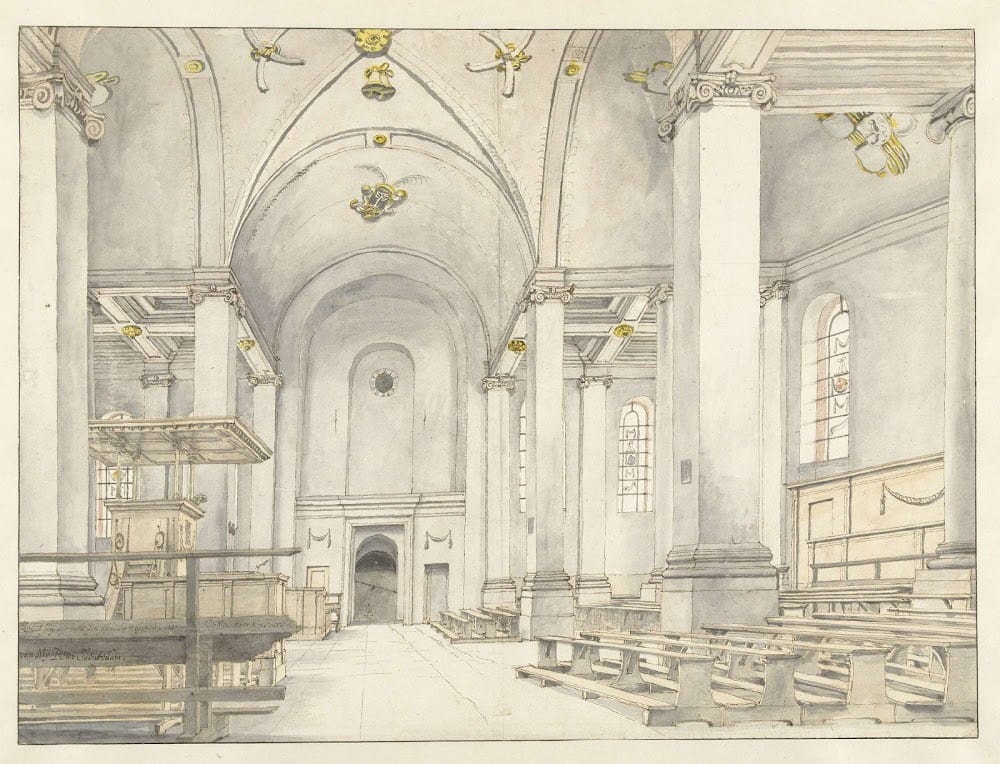
Pieter Jansz. Saenredam, View of the Nave of the Nieuwe Kerk, Haarlem, Looking West, Haarlem, 18 juni 1650, Rijksmuseum Amsterdam
It has been four months since I last published anything here. The sixth and final article in my Indoctrination Series, The Object of Power, has been waiting to be written for most of that time. The irony is that the reason I have not been able to write about decline is that I have been spending my days dealing with it.
I am currently pursuing four disciplinary complaints against doctors who put protocol ahead of their patients, two of them now on appeal. Both were dismissed without any serious examination of the facts. In one case, my complaint was rejected because the guideline telling the doctor what to do had not yet been formally implemented at the time. In the other, the panel saw no reason to question the doctor’s expertise because he had once published an article in a scientific journal. Neither decision addressed what had actually happened.
The fight has since spread to the institutions that exist to correct such failures: legal assistance, complaints committees, disciplinary boards and supervisory bodies. Everywhere, the pattern is the same. Form is administered while substance is neglected. For example, when I explain in detail why a review is inadequate, there is no reconsideration. I just receive a referral to the next procedure at the next institution.
To get anywhere at all, I have had to do the substantive work myself: explaining medical guidelines to doctors, pointing legal professionals to relevant case law and reminding disciplinary boards that judging a case means testing both sides against the facts. These are professionals whose authority rests on knowledge and independent judgment. But in today’s world, the division of labor has been reversed: I have to supply the knowledge and expertise that used to justify the authority of the professional, while the professional retains the authority to decide. It really boggles the mind.
Wherever people work, mistakes are made. Even when everything is running smoothly, individual failure is always possible. One careless doctor is incompetence. One sloppy ruling is a bad decision. But when professionals across different disciplines all fail in the same way, including the institutions charged with correcting them, something they share is disappearing. That something is more fundamental than knowledge and expertise alone: it is the capacity to perceive reality as it is.
The capacity to perceive reality as it is and work from the facts is the backbone of every profession. A doctor has to find out what is actually wrong with a patient in order to provide the right treatment. A judge has to establish what actually happened in order to provide the right ruling. Guidelines and protocols are instruments in service of that capacity, but today it looks like procedures and protocol have replaced independent thinking altogether. You can see the erosion most clearly in the questions that now dominate professional life. Where the professional once asked What actually happened, the question today is Which procedure applies? And where the review once asked Is this conclusion supported by the facts, it now only asks Did the professional follow protocol?
On the surface, it still looks as if our institutions are working. Reports are written, reviews are carried out, judgments are given. But look a little deeper, and you see that procedure has replaced the underlying work. A doctor writes an expert opinion, a committee relies on the doctor’s assessment, and a reviewing body relies on the fact that a committee has looked into the matter. Each additional step gives the conclusion more institutional weight, without requiring anyone to establish whether it is actually correct. And if no procedural failure has occurred, no one is held responsible for the wrong outcome.
That same procedural thinking has quietly corrupted independent verification too. When a second professional is brought in for an independent assessment, they are likely to use the same procedures and guidelines and converge to the same readily available answer as the professional under scrutiny. That convergence is then presented as professional consensus and used to validate the original conclusion, without anyone independently testing whether that conclusion is actually correct. Facts that contradict the expert opinion are no longer treated as facts requiring investigation, but as the personal opinion of a dissatisfied party. After all, when the experts agree, you must be wrong.
A complex society needs procedures to function. But when procedures take over, professionals on all levels and across all disciplines gradually stop thinking for themselves. Even worse, the mechanism is self-reinforcing: less understanding breeds more procedure, more procedure breeds less need for independent thinking, and less independent thinking breeds even less understanding. The result is that institutions are incrementally hollowed out from within, including the ones that are supposed to correct and supervise. Correction has become repetition, where one error compounds the next with little capacity left to change course. And when the whole society starts to function the same way, you are no longer looking at individual failure; you are looking at decline.
Decline is the long process of hollowing out a complex society, before it finally collapses. In this decades-long period, the buildings still stand and the institutions still operate, but the competence that once gave them substance is disappearing. Procedures multiply to compensate for the loss of independent thought and expertise. The first to pay the price are the citizens who rely on those institutions. They remain present in the paperwork, but disappear from the reasoning. On paper, their rights have not changed. In practice, exercising them has become a full-time job. I speak from experience: for the past four months, it has been mine.
Power does not disappear when competence does. It merely stops being transparant and accountable. That is the real Object of Power I will soon write about. Unfortunately, it will take a while longer, for I became its unwilling subject first.
To my Dutch readers:
Ik heb ook een Nederlandse Substack. Deze vindt u hier: nl.jeanettevandijk.com